
ANTIQUE GOLD & RUBY RING
We thought we knew just how special the Cob Field was. Then we finally got permission to search the other half, and within minutes everything changed.
We were back for another day of metal detecting at one of our favorite places we’ve ever hunted, a property we’ve come to simply call the Cob Field.
If you’re not familiar with the Cob Field, this is the oldest site we’ve ever detected. Based on everything we’ve uncovered there, we believe a trading post or some other early site may have once stood on the property as far back as the mid-1600s.
And by this point, the field had already produced an unbelievable amount of history.
We had found 10 or 12 coins dating to the 1600s, more than 50 buttons from the 1600s and early 1700s, shoe buckles, knee buckles, hand-forged nails and all kinds of other early relics.
And somehow, we had even managed to uncover four hammered Spanish silver cobs.
This was probably our sixth or seventh trip back. But this day was going to be different.
THE OTHER HALF OF THE FIELD
As large as the Cob Field is, there’s something interesting about the property today. A modern property line runs right through the middle of it. Up until this point, we had permission from one of the landowners and had spent all of our time searching his side of the field. The neighboring half belonged to someone else, and we had never been able to detect it.
That changed this day.
The neighboring property owner happened to be outside, so we walked over, introduced ourselves and asked if he would mind if we searched his portion of the field as well.
He said yes.
Just like that, after all those trips wondering what might be on the other side of an invisible modern property line, we finally had access to the entire field. We grabbed our detectors and headed straight into the new ground. And within minutes, the signals started coming.
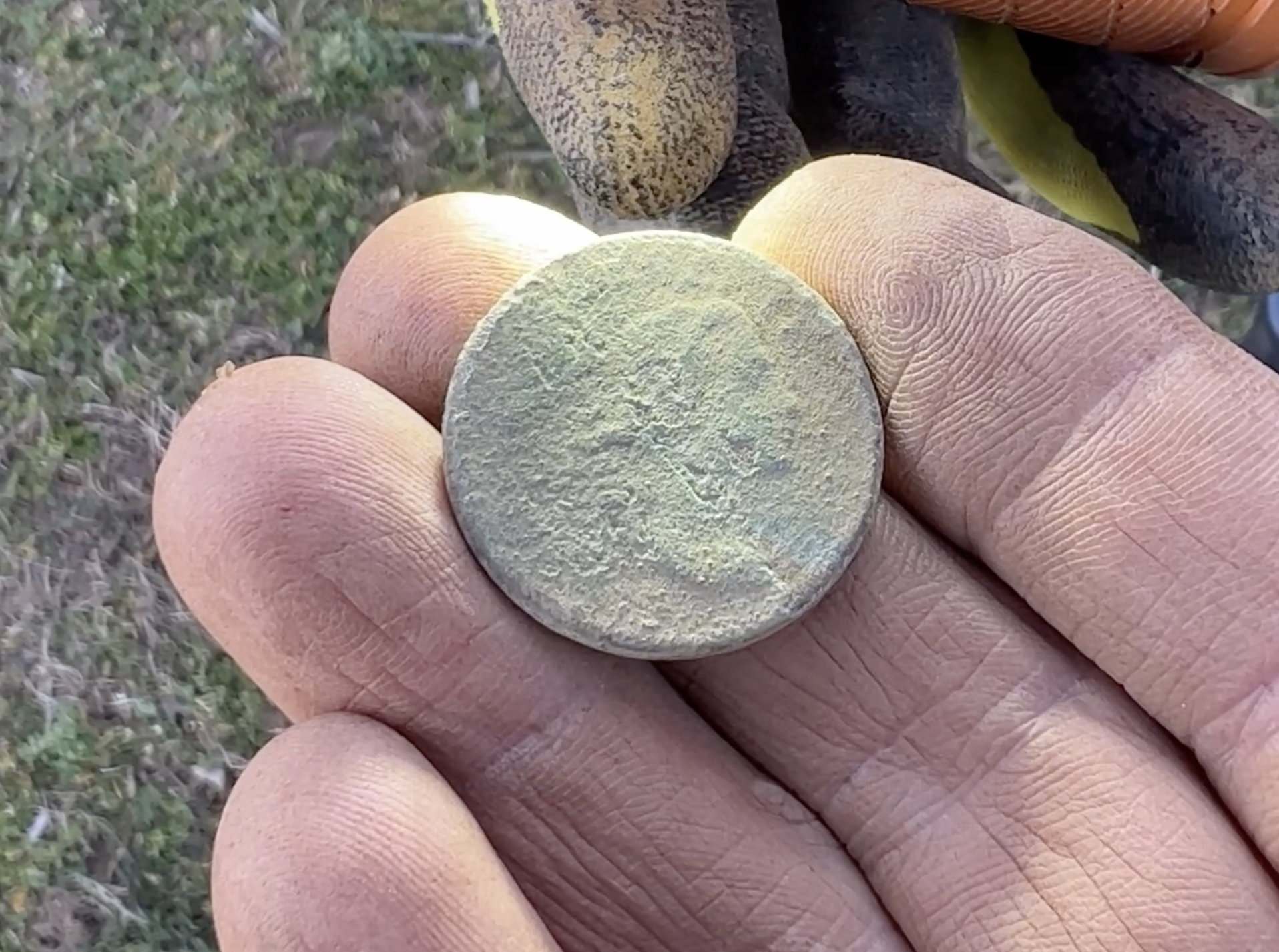
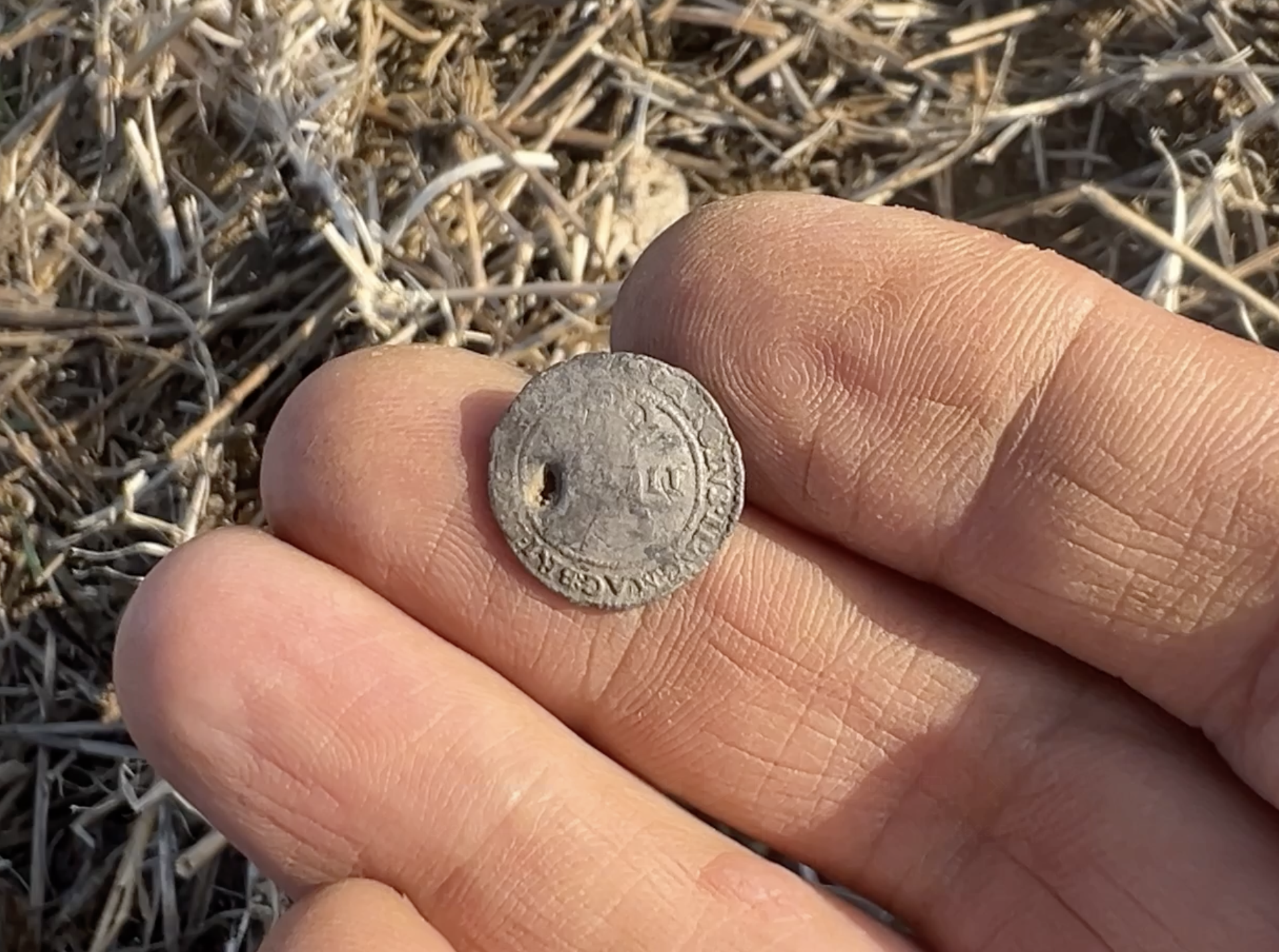
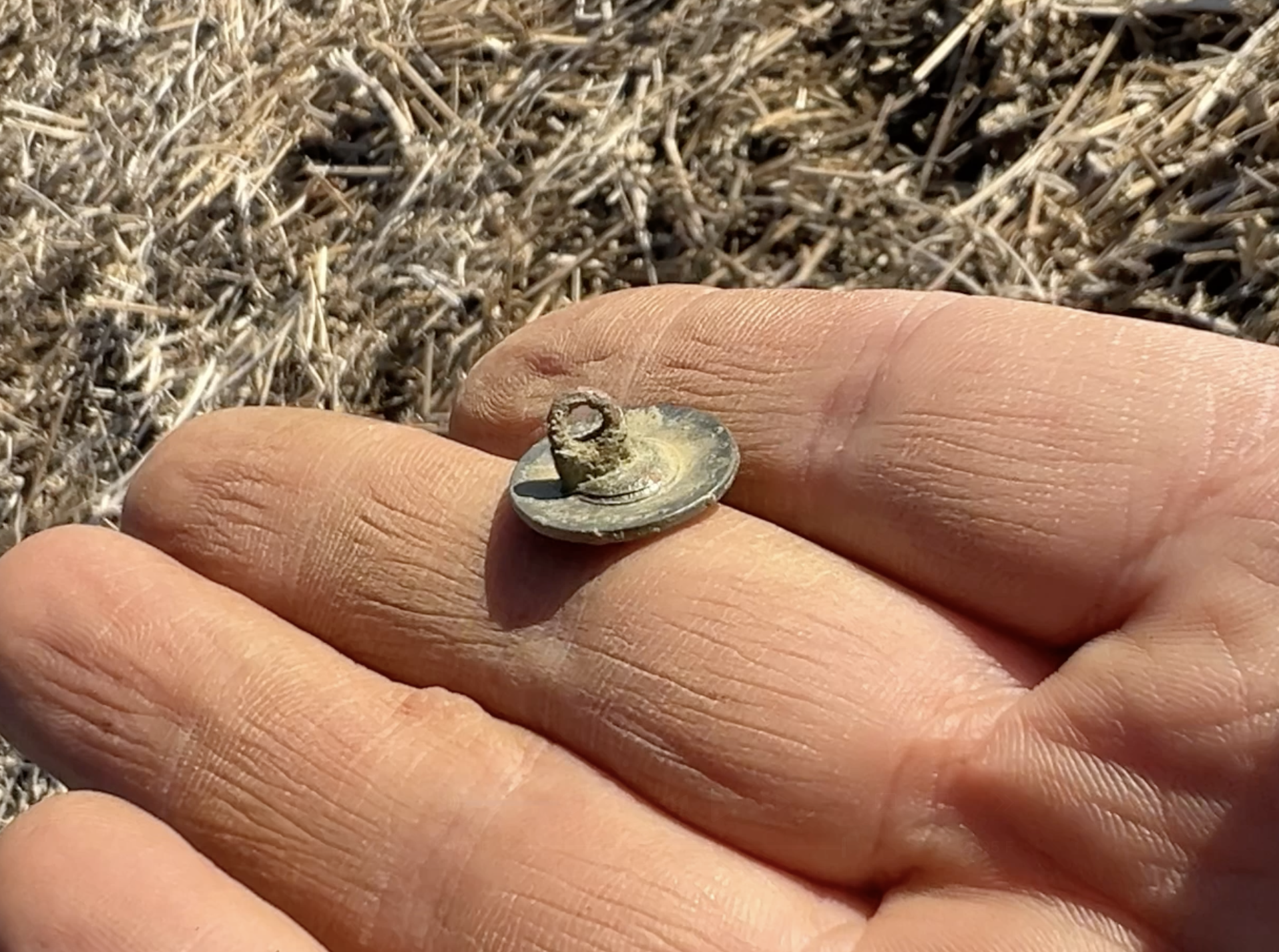
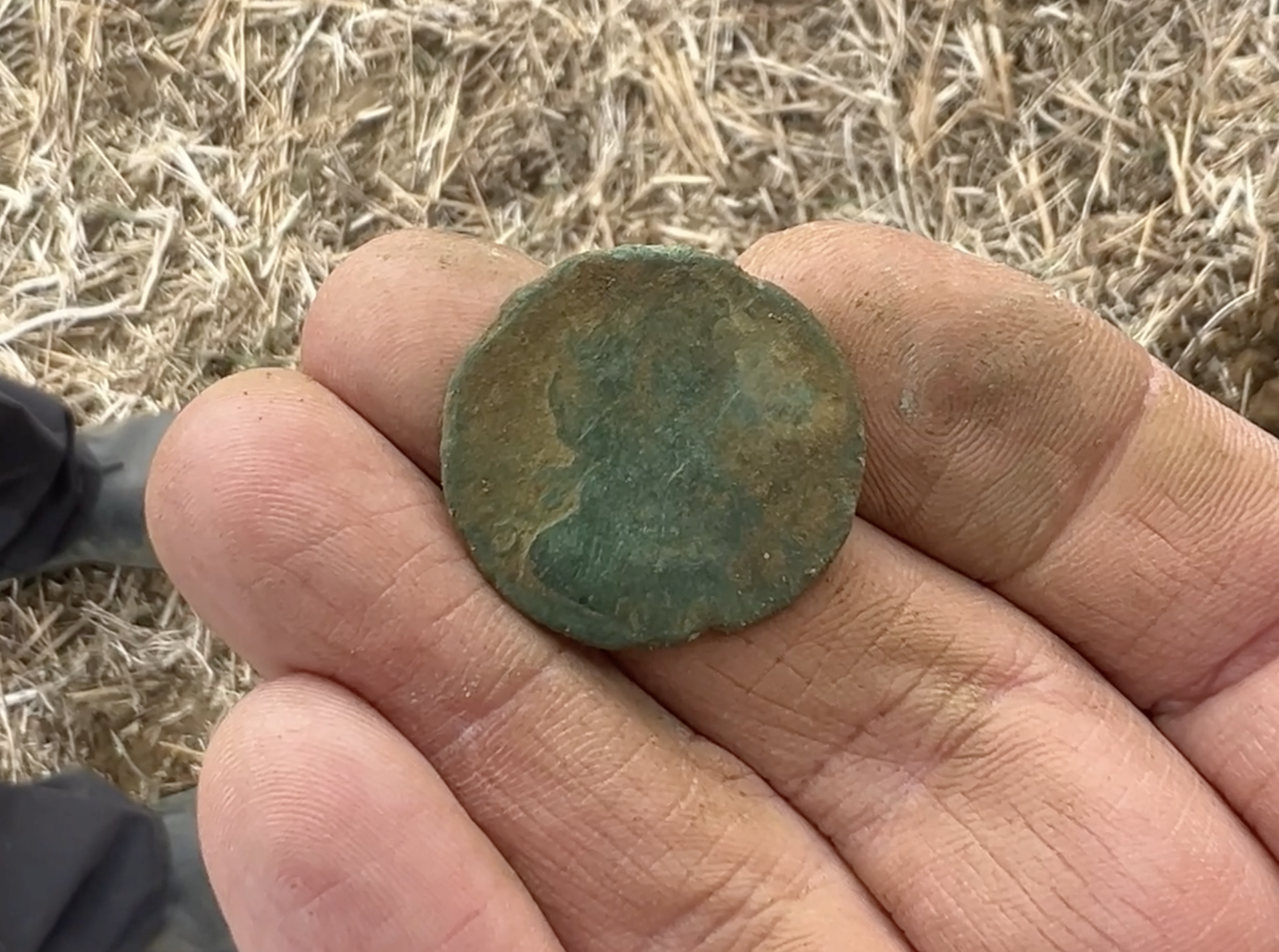
More early copper coins.
More early buttons.
More 1600’s silver coins.
The magic of the original Cob Field seemed to continue right across today’s property line, exactly as we had hoped.
But the Cob Field wasn’t finished yet. Not even close.
I was just about to dig another signal that sounded like it might be a button when I suddenly heard Charley yelling so I looked up.
He wasn’t just yelling, He was dancing.
Charles was actually dancing!
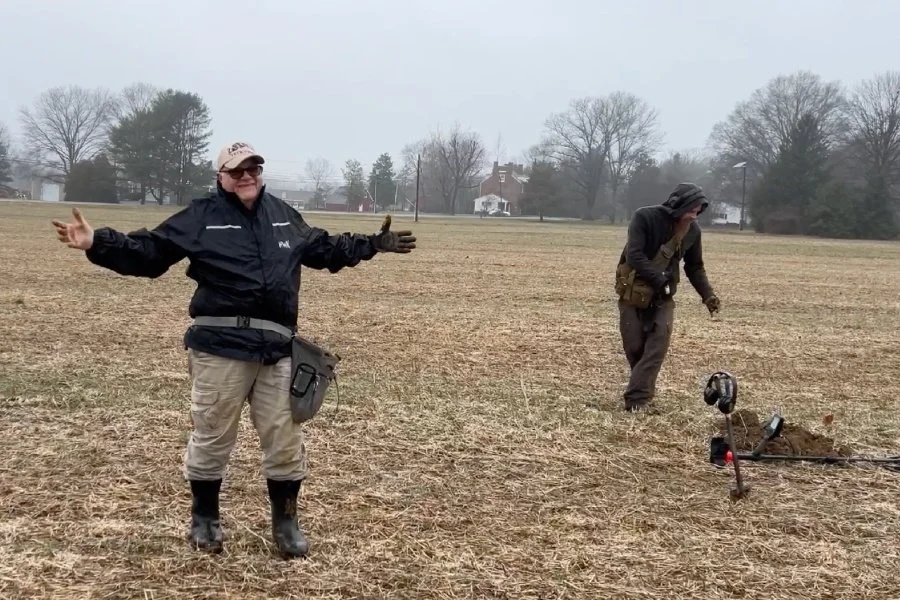
Literally dancing back and forth beside a freshly dug hole in the middle of the field. Whatever he had found, I knew it was going to be good.
I yelled for the rest of the gang and everyone started making their way toward Charley. Of course, I got there last because I had to gather up all the camera equipment.
By the time I was ready, everyone else already knew what he had found, but I still had no idea.
I turned on the camera and started walking the last 20 yards or so toward the group. Everyone was hooting and hollering, Charley was still dancing, and at this point I was preparing myself to be amazed.
Thankfully, they had left the find exactly where it was. Sitting right on top of Charley’s dirt pile. So I walked up and looked down at his freshly dug hole and I couldn’t believe what I was seeing.
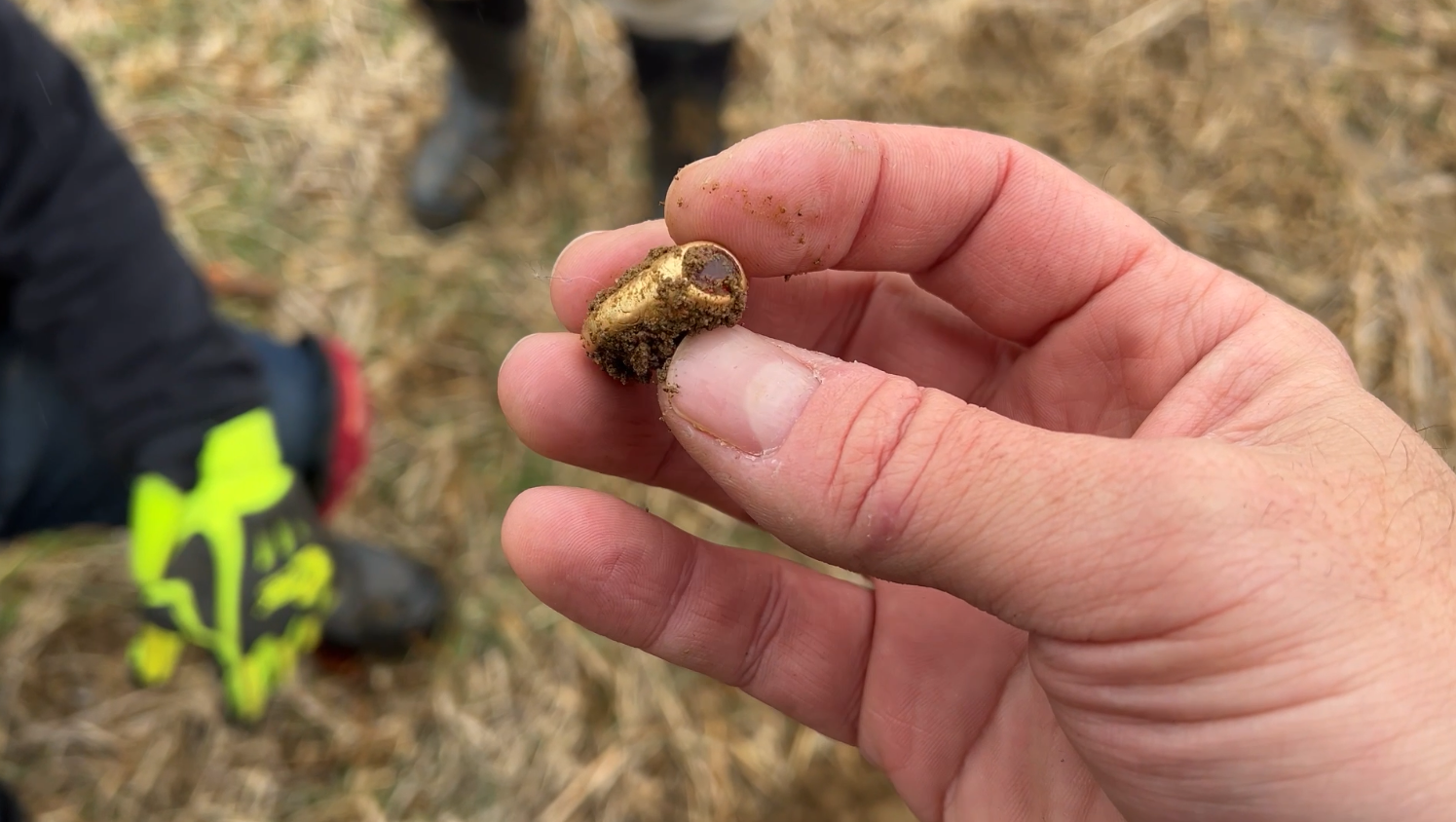
Sitting on top of the dirt was an antique gold ring.
And even underneath all that dirt, I could see some kind of red stone perched on top.
The ring exactly as Charley found it, still lying in the dirt before anyone had picked it up.
Gold in the COB Field!
We hadn’t even picked it up yet.
With the camera rolling, we lifted the ring from the dirt for the first time and started getting our first real look at it.
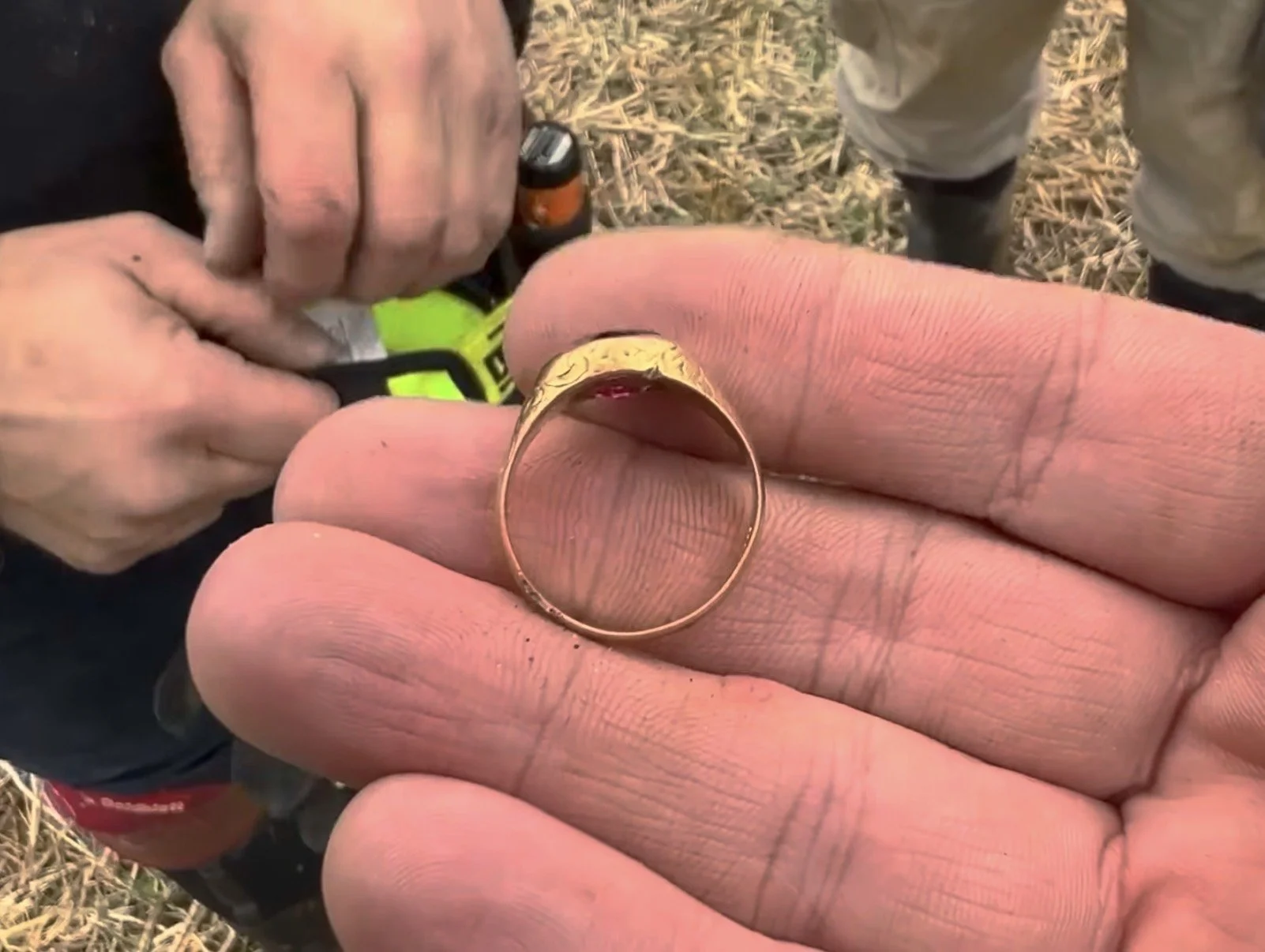
The ring was still packed with dirt, especially around the stone and the top of the band, but the gold underneath had this beautiful, rich yellow color that immediately stood out against the brown dirt.
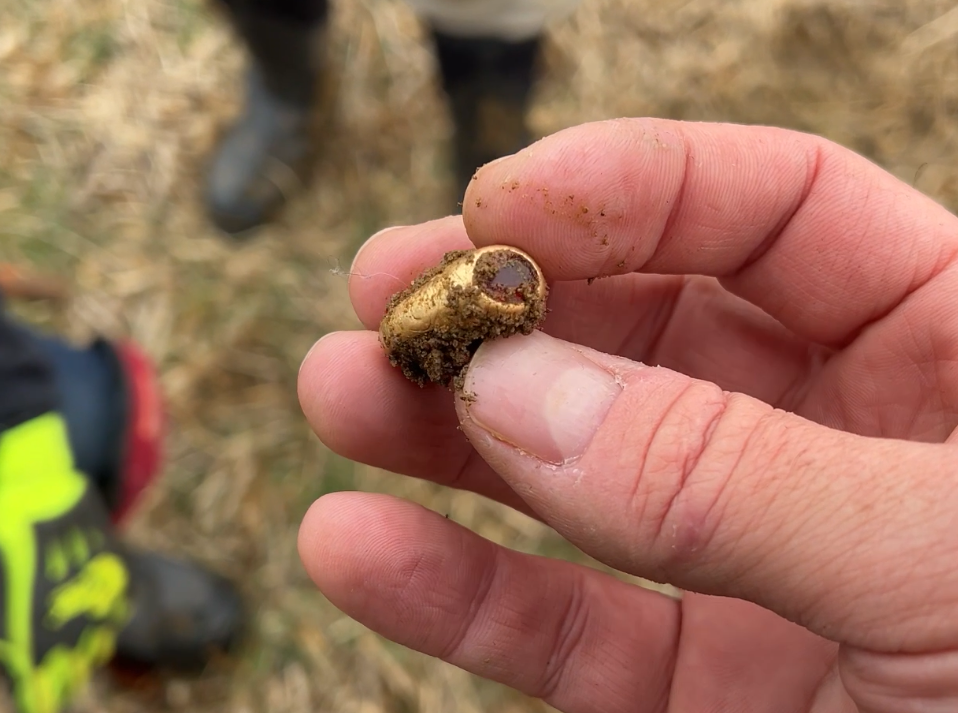
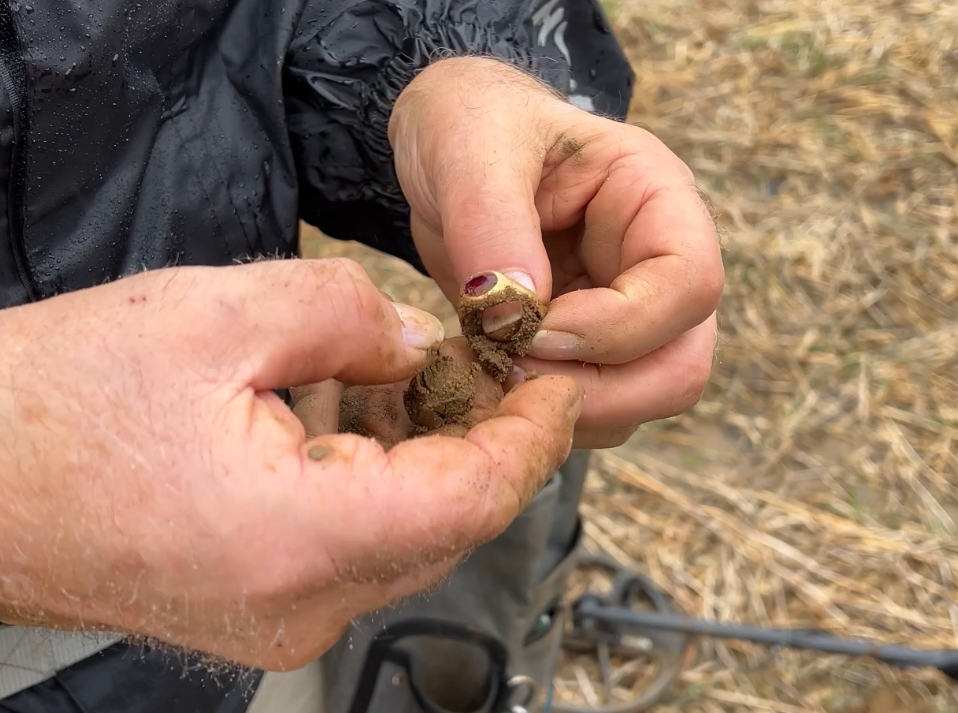
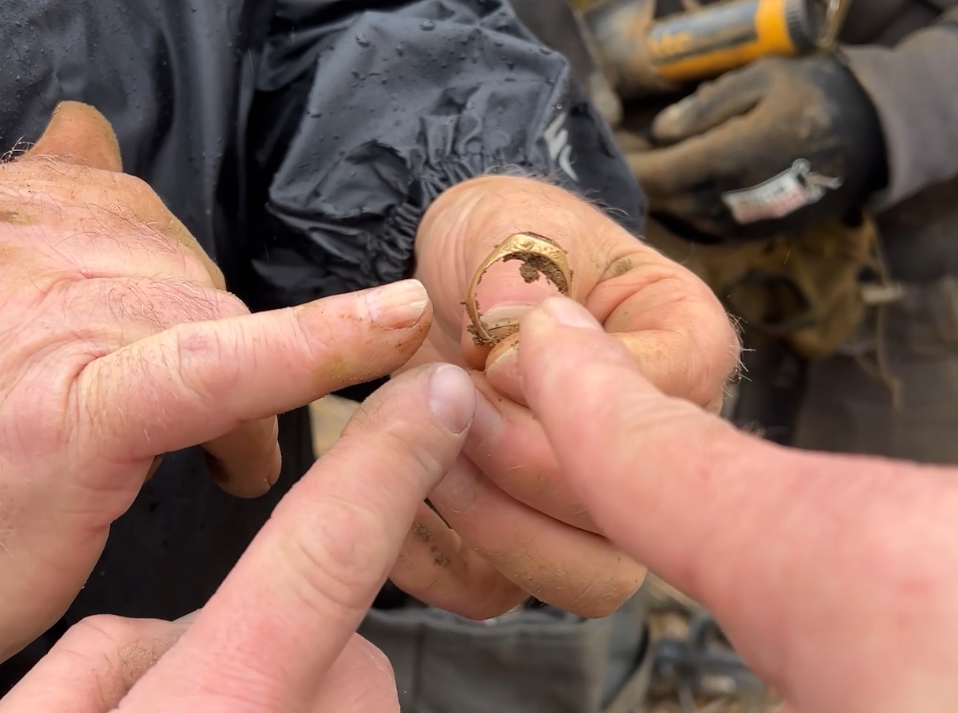
Then we started spraying it off, and with every spray, the ring got better.
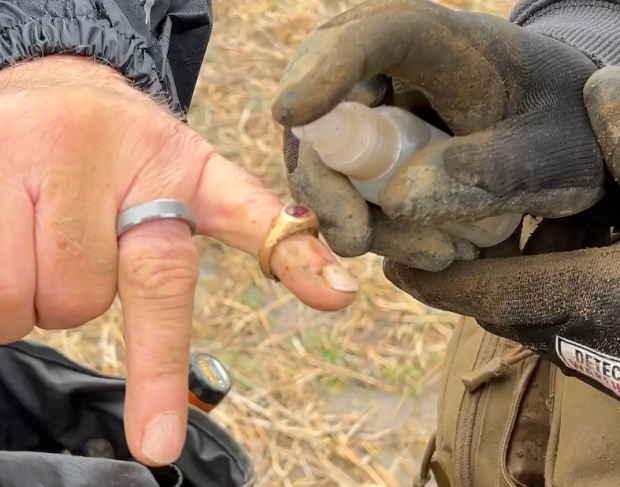
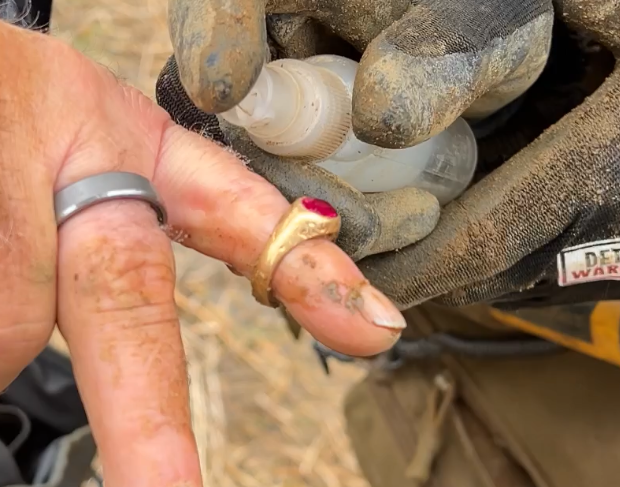
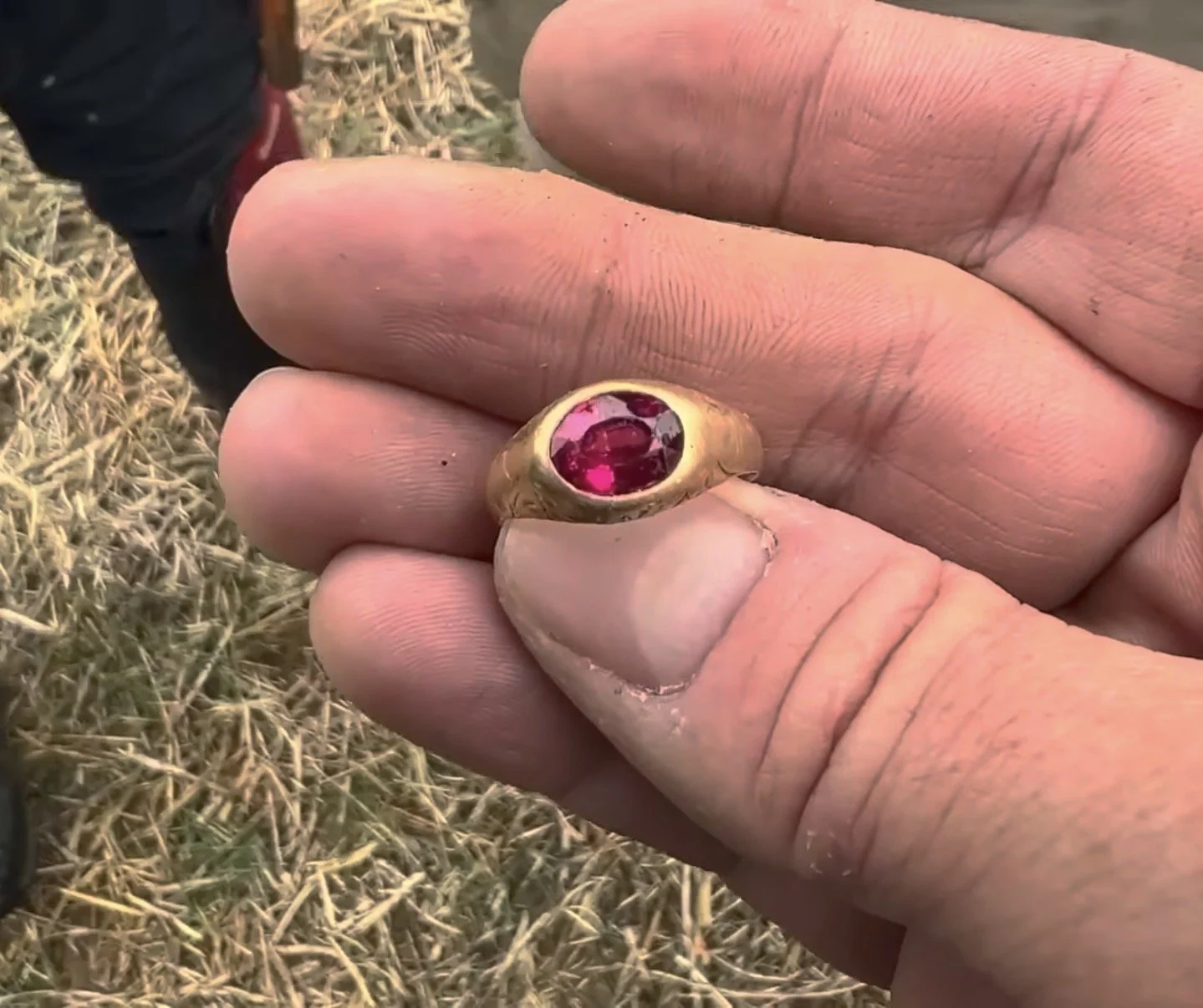
As the dirt washed away, the stone completely changed. What had looked almost dark red while it was still covered in dirt suddenly became a deep, brilliant ruby-red, with flashes of brighter crimson and almost pinkish-red light reflecting from its facets.
The stone was still completely intact. No obvious cracks. No missing pieces.
And when the sunlight hit it, it sparkled like it had been cut yesterday instead of spending who knows how many decades buried in a farm field.
It was absolutely gorgeous.
For a group of people who had just spent the morning finding 300-year-old buttons and copper coins, it takes quite a bit to stop everybody in their tracks.
This did it.
HOW OLD WAS IT?
Once the excitement settled down a little, we started looking at the ring more closely.
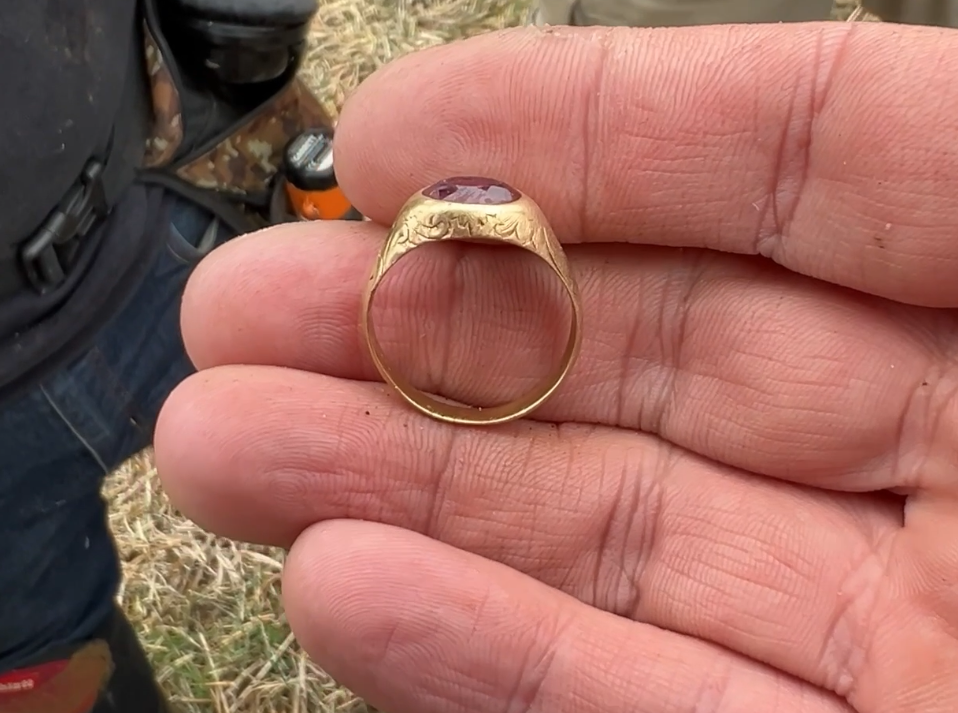
There was engraving along the shoulders of the band, and the stone sat low in the heavy gold setting instead of sticking way up above it.
Based on the style and construction, we started wondering if the ring could date to somewhere around the late 1800s or early 1900s. That would make it much newer than the earliest history we’d uncovered at the Cob Field, but still potentially more than a century old.
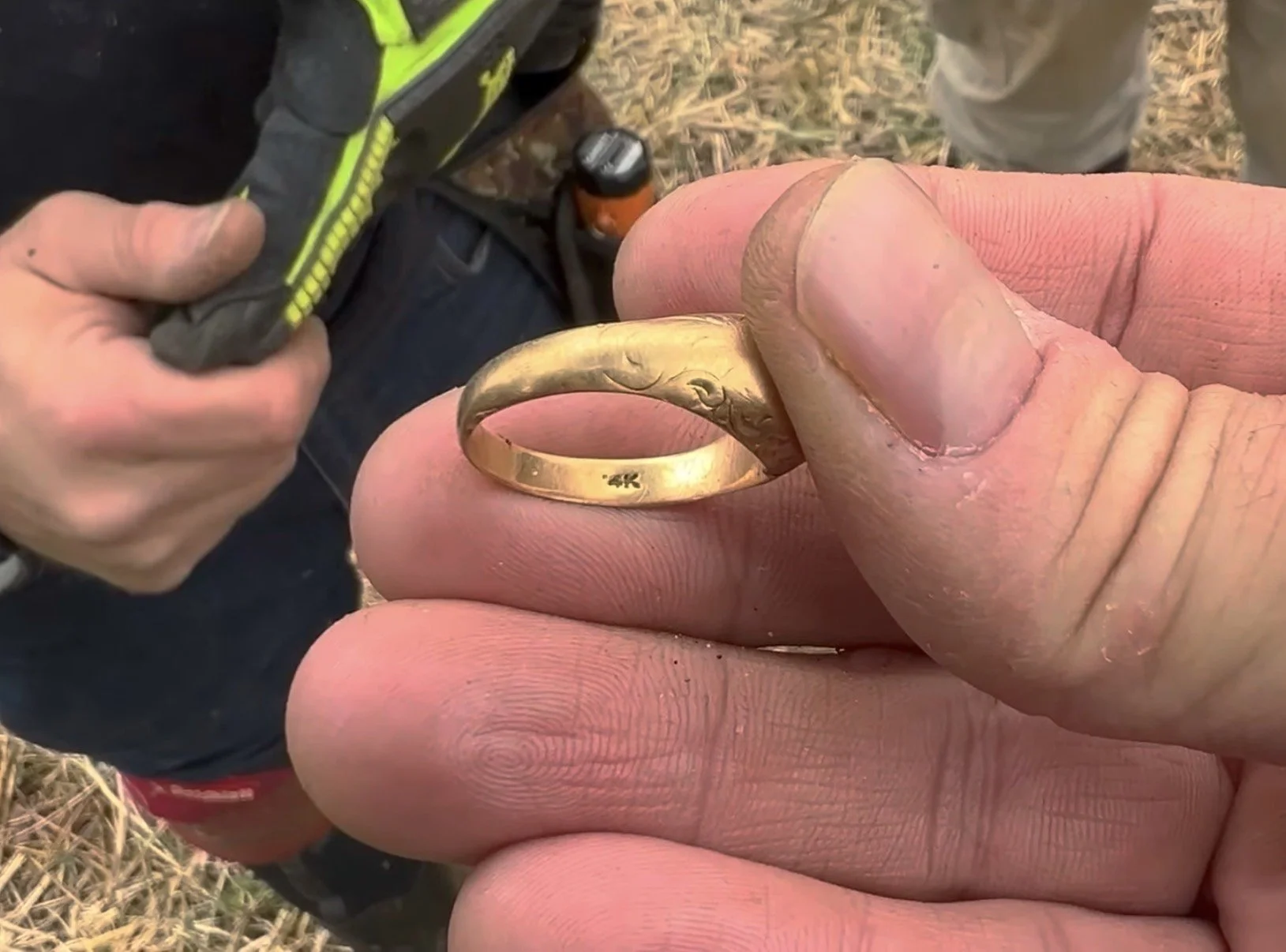
Then we looked inside the band.
There was a hallmark.
The hallmark clearly shows “4K,” but the first digit is worn and much harder to make out.
Unfortunately, part of it appeared to be worn away or difficult to make out. I could clearly see “4K,” but whatever came before the 4 wasn’t nearly as clear.
Was it 14K? Could it have been 24K?
We weren’t sure. We’ll need to have the ring tested to know for sure. What we did know was that we were holding one incredible piece of jewelry.
The heavy yellow-gold appearance, engraved decoration and low-set gemstone also fit broadly with jewelry traditions seen around the late Victorian and turn-of-the-century period. GIA documents yellow gold and decorative motifs as characteristic of Victorian jewelry, while flush or “gypsy-set” gemstones in domed ring shanks continued into the Edwardian period. That doesn’t date this particular ring by itself, but it makes our late-1800s/early-1900s guess reasonable enough to investigate further.
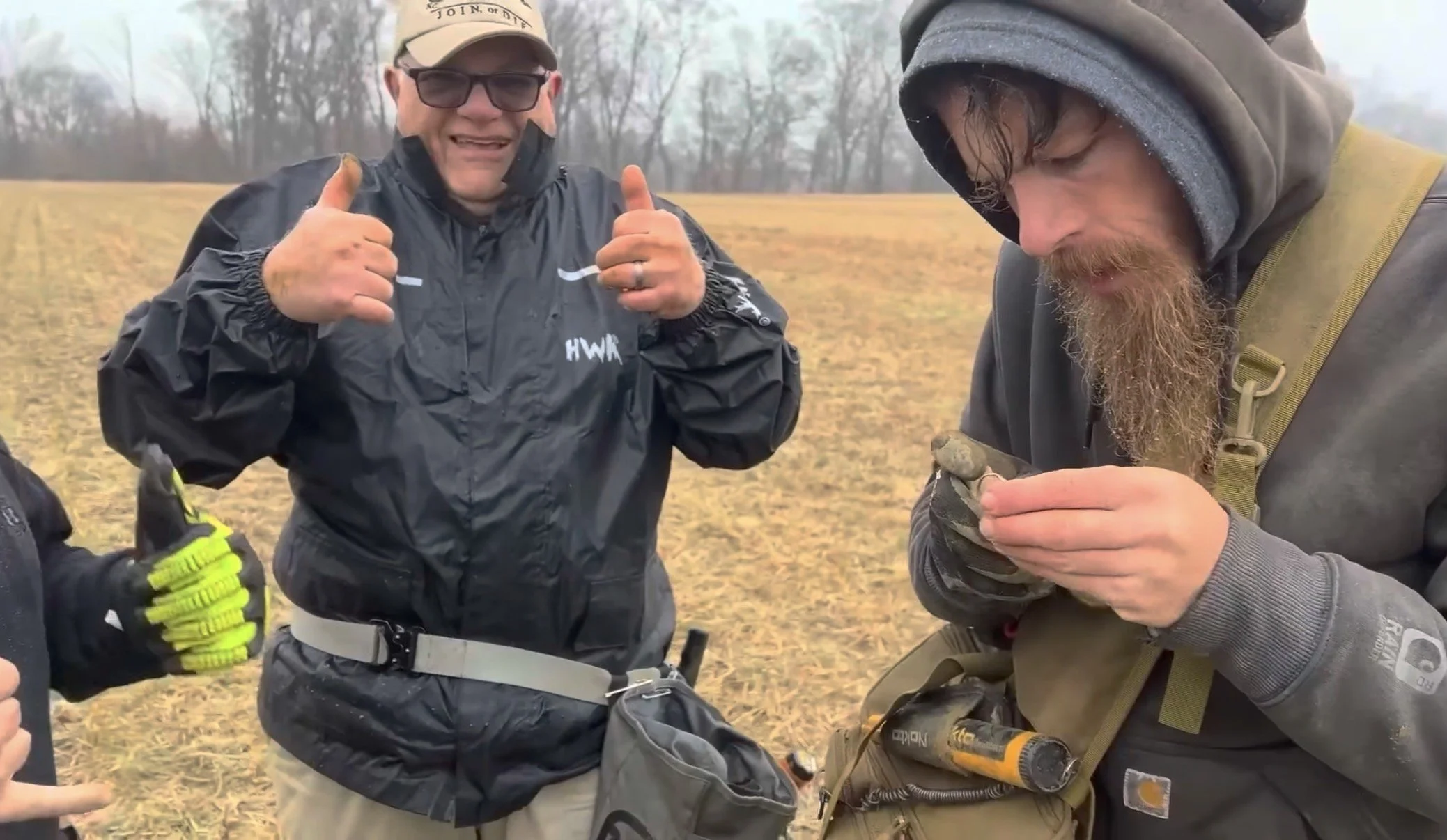
Charley smiling ear to ear as Rich inspects the ring
WHO LOST IT?
Standing there holding it, I couldn’t stop thinking about the person who had lost it. A gold ring with a beautiful red stone like this probably wasn’t something its owner would have casually shrugged off.
Maybe it marked an important occasion. Maybe it was a gift. Maybe it had been passed down through a family. Maybe the stone really is a ruby and the ring was extremely valuable for its time. We’ll probably never know.
But I can imagine the moment its owner realized it was gone.
How many times did they retrace their steps through that field? How long did they search? Did they come back the next day hoping somehow they’d spot it? At some point, whoever lost it must have accepted that it was gone forever. And for more than 100 years, maybe it was.
Until Charley walked into a part of the Cob Field we’d never been able to search before, swung his detector over exactly the right spot and brought it back to the surface.
No wonder he was dancing.
And if the person who lost it could have known that a small group of treasure hunters with magic metal-finding sticks would recover it more than a century later, I have a feeling they might have been dancing in the field too.
WATCH THE HUNT
Watch the full hunt below, or jump to 3:56 to see the Gold Ring come out of the ground.
